
How Much Does Long-Distance Moving Cost? (Updated 2026)
The sticker shock from long-distance moving costs can derail a move if you’re not prepared. The truth is that long-distance moving prices span a wide range, and what you pay depends on a handful of variables that are entirely predictable once you know what to look for.
This guide breaks down current national averages, real-world route examples, and the key factors that shape your final bill, so you can plan from a position of clarity instead of guesswork.
Average Long-Distance Moving Cost
Nationally, the average long-distance moving cost falls between $2,500 and $8,000 for most households, though moves can run as low as $2,000 for a small shipment over a distance of around 250 miles or well above $10,000 for a large home moving coast-to-coast. The primary drivers are shipment weight and total mileage.
Real-world routes help put those ranges in context. A family moving from Raleigh, NC, to Richmond, VA, for a new job (roughly 160 miles) can expect to pay somewhere between $1,800 and $3,500 for a two- or three-bedroom household, depending on shipment weight and services. A PCS move from Pensacola, FL to Dover, DE (closer to 1,000 miles) typically runs $4,500 to $8,500 or more for a family-sized shipment, before factoring in storage or specialty items. A relocation from Richmond to Jacksonville, FL (about 650 miles) generally falls in the $3,000 to $5,500 range for a mid-size home.
All of the above reflect the standard long-distance moving services cost, meaning the crew handles loading, transport, and delivery. Costs increase when professional packing is added and can decrease when you handle some of the prep work yourself.
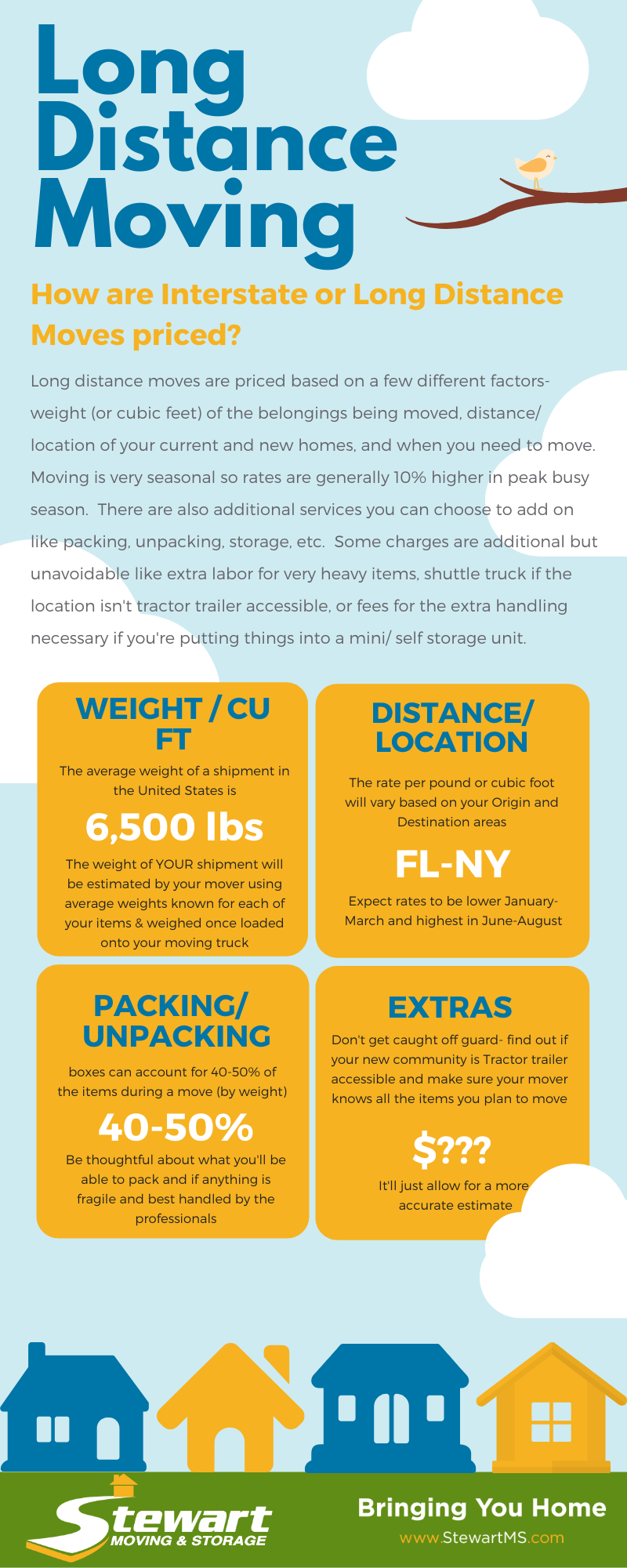
Factors That Affect Long-Distance Moving Prices
No two moves are identical, and neither are the bills. Several variables determine your specific cost for long-distance movers.
Weight or Cubic Feet
Interstate moves are priced primarily on the weight of your shipment, not the number of boxes. Your move consultant will estimate the total weight based on a detailed inventory. Anything in the garage, attic, shed, or off-site storage needs to be included. Items you plan to donate or discard should be removed before the survey, as they'll skew the estimate.
Distance and Location
Mileage is the other major pricing lever. But total distance isn't the only geographic factor. Some cities (New York being the most common example) restrict full-size tractor-trailers, which triggers a smaller shuttle truck and adds to the cost. Routes into rural areas or regions with low outbound moving traffic tend to run higher because trucks return empty. Your move consultant can flag destination-specific surcharges early in the process.
Packing and Unpacking
Professional packing adds to long-distance moving prices, but it also shifts liability. If you pack your own boxes and something breaks in transit, the carrier generally cannot be held responsible. For fragile or high-value items like artwork, china, electronics, and instruments, professional packing is usually worth the cost. For straightforward items like linens, books, and clothing, handling them yourself is a reasonable way to trim the total.
Date and Season
Demand drives pricing in the moving industry. Summer (June through August) is peak season, and rates reflect that reality. January through March consistently offers the lowest average long-distance moving cost of the year. Mid-month and mid-week bookings are also typically less expensive than weekend or month-end moves, which is when most leases turn over and competition for availability spikes.
Extras
Accessorial charges cover services that fall outside standard door-to-door transport. Common ones include shuttle trucks when your home isn't accessible to a full-size trailer, long-carry fees for stairs or elevators, and specialty handling for heavy items like pianos, safes, or pool tables. Third-party crating for fragile or custom pieces is another potential add-on. None of these should catch you off guard — your estimate appointment is specifically designed to surface them before anything gets signed.
How Long-Distance Movers Calculate Costs
Professional interstate movers use a regulated pricing structure. Your move is priced based on the actual weight of your shipment multiplied by the mileage, then adjusted using the carrier's tariff rates.
Your move consultant handles the survey and builds the estimate. Once you book, a dedicated move coordinator takes over to manage scheduling, logistics, and your delivery window. That handoff is particularly important for military families working within firm PCS reporting dates, because your coordinator is the point of contact who keeps everything on track.
How to Save Money on Your Long-Distance Move
- Declutter before the survey. Shipment weight determines your base rate, so less is genuinely more.
- Book in winter. January through March consistently delivers the best long-distance moving prices of the year.
- Pack what makes sense. Handle easy categories yourself and leave fragile or bulky items for the crew.
- Schedule for mid-month or mid-week. Avoiding peak move dates can produce meaningful savings.
- Book early. Waiting until the last minute limits availability and often pushes rates higher.
- Be thorough during the estimate. Accurate inventories prevent surprise charges on moving day.
Why Choose Stewart Moving & Storage for Your Long-Distance Move?
Stewart Moving & Storage has been handling long-distance moves for more than 25 years. The company was built on military moving; it's not a service line that was added later, it's the foundation. That heritage shapes how we operate: with discipline, precision, and a genuine understanding of what's at stake when a family picks up and relocates on a tight timeline.
Today, Stewart operates across 12 warehouse locations in Virginia, Maryland, Delaware, North Carolina, and Florida, with 125+ trucks and more than 200 trained employees. We hold an A+ rating from the Better Business Bureau and carry AMSA ProMover certification.
Getting started is straightforward. Stewart offers three estimate options so you can choose the approach that fits your schedule.
FAQ about Long-Distance Moving Services Cost
What is the average cost of a long-distance move for a 3-bedroom home?
For a 3-bedroom home, the average long-distance moving cost falls between $3,500 and $7,500, with mileage and service level as the main variables. A 300-mile relocation typically comes in toward the lower end of that range; a move spanning 1,000 miles or more can push $8,000 to $10,000 or higher for a fully packed household. An in-home survey with your move consultant is the most reliable way to get an accurate number for your specific situation.
Is it cheaper to use PODS or a moving company?
Container services like PODS typically cost less than hiring full-service movers. The trade-off is labor (you handle all packing and loading), and delivery windows tend to be broader than what a professional mover provides. For families with tight schedules, including those managing a PCS move with a firm reporting date, the time and physical cost of a DIY approach often outweighs the savings. Stewart also supports hybrid arrangements: Our crews can load your rented container or truck if you want to manage transport costs while still getting professional loading.
Should I Tip My Movers?
Tipping isn't required, but it's a practical way to recognize a crew that's worked hard on your behalf. For a long-distance move, $20 to $50 per mover per day is a reasonable amount (more if the job involved particularly difficult conditions, like multiple flights of stairs, excessive heat, or a complicated load). Tips are typically given in cash directly to the crew at the end of the move. Check out our complete guide to tipping movers here.
Is It Cheaper to Move During Certain Times of the Year or Week?
Yes, and the difference can be significant. The lowest long-distance moving prices of the year consistently fall between January and March, when residential demand drops and movers have more scheduling flexibility. Summer is the most expensive period, and availability fills up quickly if you wait too long to book.
Within any given month, mid-month moves tend to be less expensive than those scheduled in the last few days, when leases typically turn and demand spikes. Weekday scheduling is also generally cheaper than weekends. If your timeline gives you any flexibility, choosing an off-peak date is one of the most effective ways to reduce your total cost without sacrificing service.